
Customer Story – City of Raleigh: From Site Search to AI Chat

From Search Redesign to AI-Powered Conversations: How the City of Raleigh
Keeps Evolving Its Digital Front Door

Problem
As one of the fastest-growing cities in the U.S., the City of Raleigh needed a search experience that could keep pace with rapid population growth. And later, with residents who began expecting conversational self-service.
Needs
A modern search platform that was fast and affordable to implement, with room to grow into AI-powered experiences as resident expectations changed.
Solution
Cludo’s AI-powered site search and AI Chat help Raleigh residents find answers faster, while giving the city’s digital team ongoing insight into where the website’s content falls short.
A Fast-Growing City, a Sunsetting Search Tool
With roughly one million page views each month, the City of Raleigh, North Carolina’s website isn’t just a digital presence. It’s the primary way residents find services, file permits, pay utility bills, and get answers.
When Google Search Appliance was sunset in 2019, Raleigh was also in the middle of a major website redesign. Finding a replacement search solution quickly became a priority. The team at Raleigh needed something that could be implemented quickly, work within a tight budget, and fit seamlessly into its redesigned website.
“We looked at a couple of different technology solutions, Cludo being one of those. Some of the things that attracted us to Cludo were good technology, a lightweight implementation that wouldn’t require massive investments in professional services or staff time, and from a cost perspective, this was something we could definitely afford.”
After evaluating their options, Raleigh chose Cludo, and the implementation that followed set the tone for a partnership now spanning more than seven years.
A Search Experience That Just Worked
Raleigh launched Cludo using a template, giving the team a simple way to match the look and feel of the redesigned site. The launch went better than anyone expected.
“Launching Cludo on the Raleigh site went eerily well,” says Jim. “A credit to the technology is that from never hearing of it to doing a pretty technical API integration, at a 5% investment in time, we were able to do it. Out-of-the-box it just worked. The search just worked.”
In a city where residents are vocal, silence after a major website change is rare. But that’s exactly what happened. The search experience launched smoothly, and teams across Raleigh were able to manage without extensive training.
When Search Data Becomes a Content Strategy
Once Cludo was live, Raleigh’s team began using search analytics to uncover something even more valuable than search itself: the gaps between what residents were looking for and what the website was actually delivering.
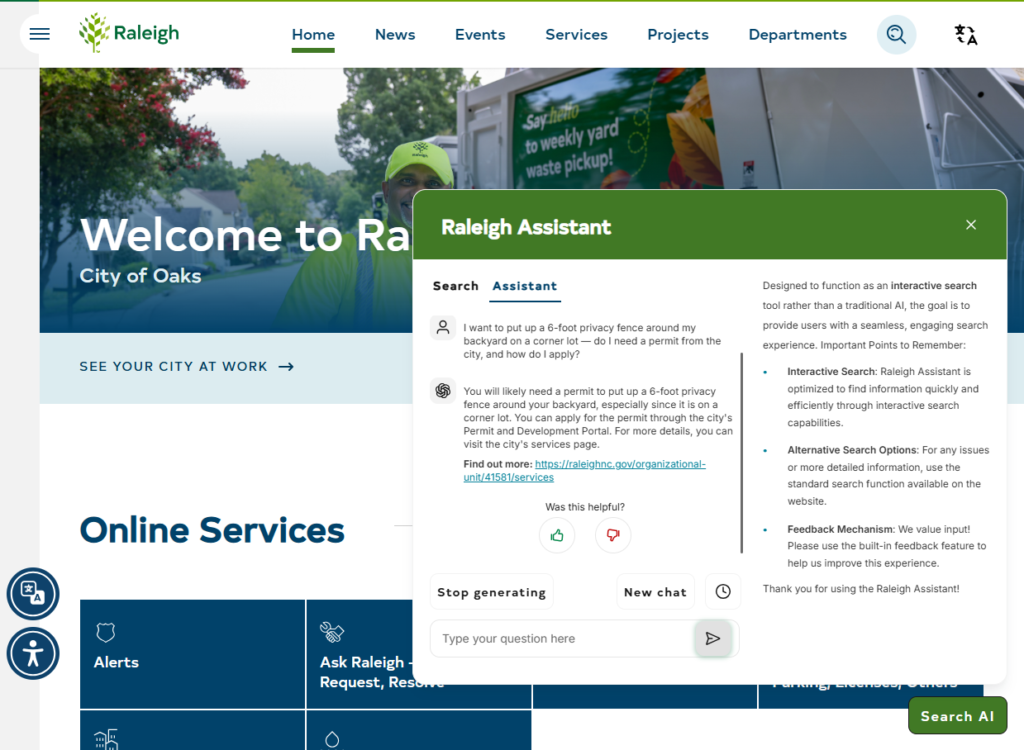
One search stood out: “fences.” “Fences” was surfacing as a popular search term, but the results pointed residents to parks with fencing, not to fence permit information. That kind of gap would have gone unnoticed without visibility into search behavior.
“The first step to increasing your searchability,” as Jim put it, “is making sure that the thing that people are searching for is in your content.”
The team created a feedback loop between search insights and content improvements, using Cludo to apply boosting and optimize results without involving developers.
Embracing AI: Why Raleigh Added AI Chat to Their Digital Front Door
Raleigh’s search strategy continued to evolve alongside changing resident behavior. Like many organizations, the team noticed people were no longer typing just keywords. They were asking full, conversational questions.
That shift reinforced the case for AI Chat. Jim saw three main reasons it made sense:
- Resident expectations were being set by consumer AI elsewhere: residents were arriving at Raleigh’s website expecting a conversation, not a search box.
- The website is Raleigh’s most important communication channel —its “digital front door”— and making it as useful as possible is a core responsibility.
- Raleigh sees itself as a responsible early adopter of emerging technology, and a municipal website built entirely on public, non-sensitive information is close to an ideal environment to pilot AI.
“The public-facing website is, in our opinion, almost a perfect opportunity. It’s all public information,” says Jim. “It has the guardrails of information that is publicly accessible and non-sensitive. It seemed like a no-brainer to advance in that direction.”
The Raleigh team took a deliberate approach to the rollout. Some residents would treat AI Chat like a search box, while others would expect it to know their address or service history. To set expectations, the team added onboarding guidance, tested internally, gathered feedback, and launched with clear guardrails.
From Search Box to Conversation: AI Chat Finds Its Audience
By mid-2026, Raleigh had seen steady growth in AI Chat adoption. While traditional search remains the primary way residents find information, the team is seeing a growing number of residents turn to conversational search.
“We’ve definitely seen people switch from using a standard search to using the chatbot,” says Nicole Benes, Senior Web Developer at Raleigh. “There’s definitely a segment of our users that have switched to chat versus a regular search.”
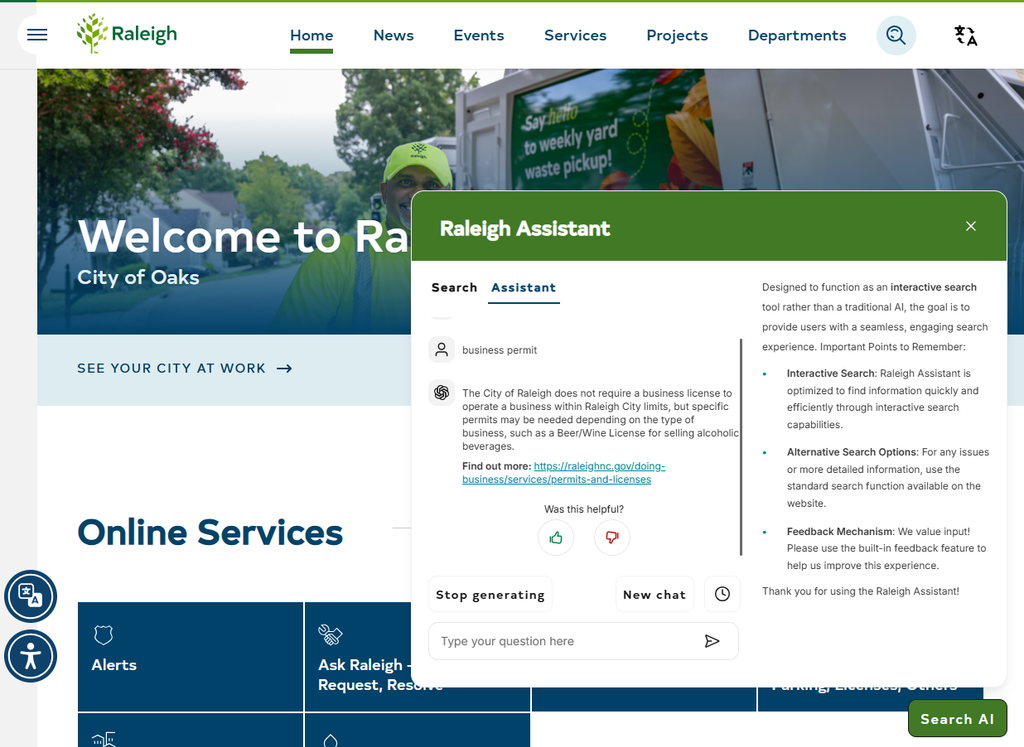
Since launch, the team has closely reviewed prompts and responses to ensure answers remain accurate and helpful.
“We’ve been able to streamline the experience for folks who have an expectation or desire to make things seamless and efficient,” says Jim. “The old experience: keyword search, list of results, click into pages, find what you need… we’ve simplified that for a whole segment of our users. We’re seeing the things that we know would be emails and phone calls being answered through AI Chat.”
Nicole noticed another pattern worth calling out: the diversity of how residents actually use it. Most people still treat it like a traditional search box, typing short phrases like “pay water bill” and expecting a result. A smaller but growing segment engages more conversationally, providing context and asking follow-ups. The beauty of AI Chat is that it can handle both.
Unexpected Insights from AI Chat
AI Chat revealed two trends that caught the team off guard.
The first was the sheer volume of utility-related questions. As a city that runs its own utility, residents ask a lot about paying bills, modifying services, and understanding charges. They’re asking through AI Chat in numbers the team didn’t anticipate.
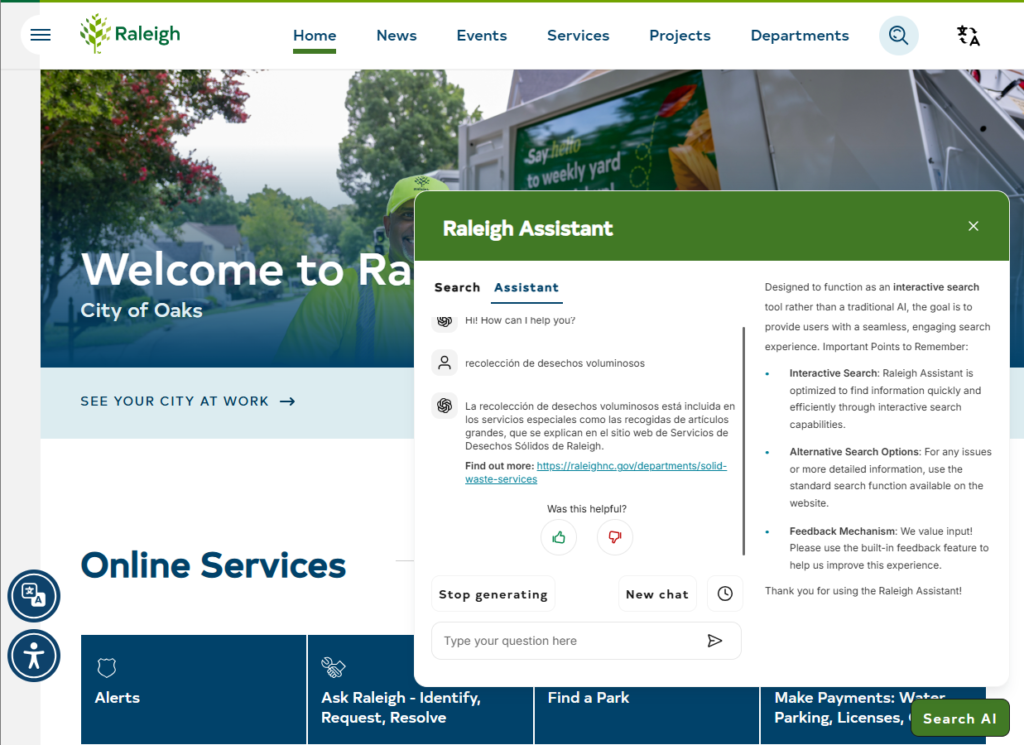
The second being language. Residents are prompting in languages other than English. Raleigh didn’t set out to build a multilingual assistant. But residents naturally began asking questions in multiple languages, highlighting a growing need the team now hopes to address.
What’s Next: Advancing with AI Responsibly
Jim describes Raleigh’s approach to AI as “cautiously advancing,” where moving too fast can erode public trust, but moving too slowly means residents may not benefit from new technologies.
On the horizon, Raleigh is closely watching Cludo’s newer conversational and generative-answer experiences. The team is exploring AI Summary, which surfaces a generated answer at the top of standard search results, and sees it as a natural next step.
“People are starting to come to expect that when they do a search, the AI has an answer, rather than having to click on a page,” says Nicole. “I definitely think it’s an awesome complement, to give people options so they can approach the content how they want to, versus forcing them to approach it a certain way.”
The goal is simple: give residents options rather than forcing a single interaction model on everyone. Traditional search, AI Chat, and AI Summary each serve different needs.
For other cities weighing the same leap, the Raleigh team’s advice is direct: go for it, just set expectations honestly, including the fact that any AI can hallucinate. A practical benefit most cities don’t initially consider:
“It provides us better insight into the gaps in our content,” says Jim. “That’s both a benefit and a little bit of a challenge. And I’m very sure that people are going to be interacting with AI significantly more than they are today — so we need to be preparing our content, data, and experience for that use case as quickly as we can.”
Looking Ahead: A Partnership Seven Years in the Making and Still Evolving
What began as a replacement for a sunsetting search tool has grown into a long-term partnership focused on improving how residents find information. As expectations evolve, Raleigh continues to adapt, and Cludo continues to develop alongside the City.
While Raleigh continues preparing for the future of resident search, its focus remains the same: helping people find the information they need as quickly and easily as possible.
- 2019Google Search Appliance sunsets; Cludo launches with the redesign
- OngoingSearch analytics drive a content-improvement loop
- Mid-2026AI Chat adoption grows steadily as the Raleigh Assistant
- NextExploring AI Summary on top of search results
