
Customer Story – Massachusetts College of Liberal Arts

Small Team, Big Impact: Massachusetts College of Liberal Arts’ AI-Powered Search Success

Problem
MCLA’s website had become an “overgrown garden” where even leadership couldn’t find basic information – leaving prospective and existing students lost and frustrated.
Needs
A search solution that could guide students to answers quickly, provide visibility into what users needed, and remain manageable for a small marketing team without requiring constant expert maintenance.
Solution
Cludo helped MCLA reposition site search as a strategic digital channel, driving a 19.2% rise in search engagement, a 15.2% improvement in click-through rates, and a 57% reduction in unanswered queries with AI-driven chat, summaries, and analytics.
The Challenge: When Your Digital Front Door Becomes a Barrier
Massachusetts College of Liberal Arts (MCLA) is a public liberal arts college nestled in the Berkshire Mountains of western Massachusetts. As a smaller institution with a lean marketing team, MCLA needed digital solutions that could deliver enterprise-level results without enterprise-level resources. But first, they had to acknowledge a fundamental problem with their digital presence.
Kristin Nichols describes the moment of realization:
“I joined as CMO and immediately noticed I couldn’t find information on my own institution’s website. If I was struggling, our prospective students and families were struggling even more.”
The website had become what Kristin calls an “overgrown garden.” Years of content accumulation without systematic governance meant content lived on the site with unclear ownership. Outdated information dominated search results: old program details, past year’s events, information that should have been archived long ago.
But the content disarray was only part of the problem. The search function itself had become a “black box” with no visibility into what users actually needed. Staff and students alike abandoned the site search entirely, going straight to Google instead. For a small marketing team already stretched thin, there was no way to know what content gaps existed or what questions students were asking.
The real-world impact hit hardest for the students MCLA serves best: first-generation college students navigating higher education for the first time. These students needed clear, accessible information about programs, costs, deadlines, and financial aid. Instead, they encountered a maze.
The Approach: Partnership Over Product
MCLA knew they needed more than just a tool, they needed partners who understood their constraints. Working with ERI Design, they conducted a comprehensive audit across admissions, academics, student life, and communications to understand where users got stuck and what information truly mattered.
When evaluating AI search platforms, MCLA had specific criteria. As Kristin explains:
“Some options felt like tools we’d have to heavily manage and become experts in just to keep running. We needed something that lifted the load, not added complexity. Cludo gave us visibility while staying manageable for our small team.”
What sealed the decision was Cludo’s approach to partnership: ongoing support, regular optimization, and a shared commitment to continuous improvement. By November 2025, the new search experience launched across the full site.
The Solution: AI-Powered Search That Actually Works
The new search experience brought together several powerful capabilities designed specifically for higher education:
Comprehensive indexing across MCLA’s main website, subdomains pages, and PDF documents meant students could find information wherever it lived. No more dead ends because content lived on a different platform.
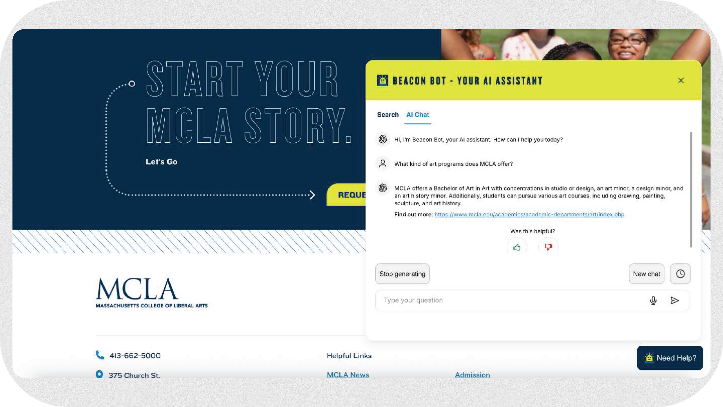
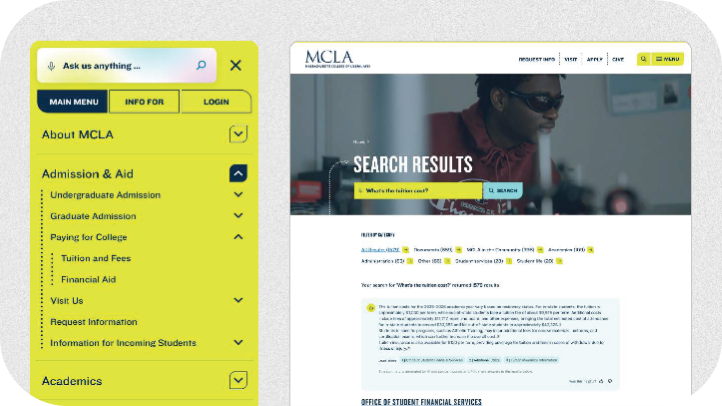
AI-powered features transformed how their search worked. AI Search blends traditional keyword matching with vector search, so whether students type “how much does it cost” or simply “tuition,” they get relevant results. AI Summary provides instant answers with in-text citations, perfect for quick questions on mobile devices. And the Beacon Bot uses AI Chat to offer a conversational interface for students who don’t know the exact terminology to use.
Smart optimization helps MCLA surface the right content at the right time. Page rankings ensure critical content like tuition, programs, and deadlines appear first. Synonym management connects related terms – tuition, cost, fee – so students don’t need to guess the “right” word. And banners can highlight non-crawlable content when needed.
Perhaps most valuable for MCLA’s small team: real-time analytics that provide visibility into what students are searching for, which questions go unanswered, and where content gaps exist. The team could now make data-driven decisions instead of guessing.
The Snowstorm Story: When Data Reveals What Users Really Need
Sometimes the most powerful insights come from unexpected moments. In January 2026, a major snowstorm hit New England. MCLA closed campus for safety, as they are accustomed to doing in the winter. But this time, they had search analytics showing them something they’d never seen before.
Students and families were asking questions through search and AI chat:
- “Who decides when campus closes?”
- “How are decisions made about campus closures?”
- “How do I find out about weather closures?”
“I had no idea people wanted to know all of this information, but here we are. They clearly did.” Being Kristin’s reaction.
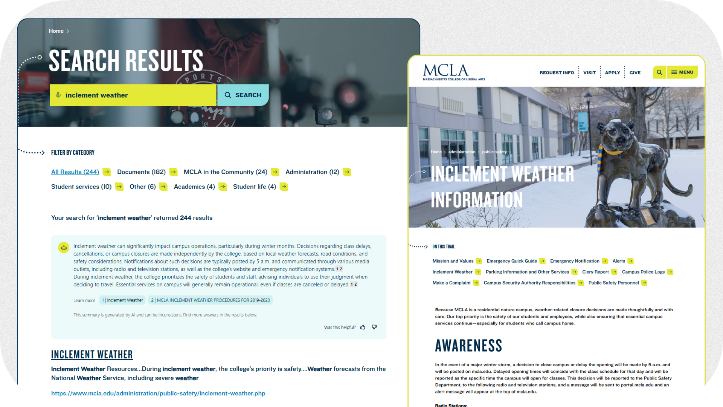
MCLA quickly created an Inclement Weather FAQ page explaining the decision-making process, chain of communication, and notification methods. During closures, it’s linked prominently from the homepage banner.
This wasn’t a crisis response or a lucky guess. It was a direct result of listening to what users were telling them through their search behavior. Real recurring questions, answered permanently – not buried in emails or social posts that disappear. That’s the power of having data-driven visibility into student needs.
The New Reality: Students Finding Answers
The contrast between MCLA’s old and new search experience isn’t just about metrics, it’s about a fundamental shift in how students interact with information.
Before Cludo, search volume was lower because students would click through to results, not find what they needed, and give up. The site became something to endure rather than a helpful resource. Staff had no visibility into what was working or where students were getting stuck, so improvements were based on guesswork. Content governance was reactive, leading to problems surfacing only when someone complained.
After Cludo, search volume increased because students began trusting it as a reliable tool. Higher click-through rates and fewer unanswered questions meant they were finding what they needed. Content governance became proactive and data-driven, like the inclement weather FAQ that emerged from search analytics, not complaints.
The mobile experience improved dramatically as well. Students no longer needed to open multiple pages to find an answer. AI summaries provided quick responses with citations right in the search results, perfect for prospective students browsing on their phones.
Perhaps most importantly, MCLA’s small marketing team went from overwhelmed and reactive to strategic and insight-driven. They weren’t guessing anymore, they were listening.
Key Lessons and Impact: Small Team, Enterprise Results
MCLA’s transformation offers four critical insights for institutions facing similar challenges.
- 1 Treat search as strategic, not utility. It’s a primary entry point and interaction point – not just a utility to tuck in the header and forget. MCLA proved this by seeing search volume increase from 2,600 to 3,100 searches per month – a 19.2% jump signaling students began trusting it as their go-to resource.
- 2 Listen to the data. The snowstorm story demonstrates this perfectly: users will tell you what they need if you’re paying attention. Search analytics reveal questions you didn’t know students were asking and content gaps you didn’t know existed. This shift from guesswork to listening helped MCLA cut unanswered questions by 57% in just two months, meaning students who previously hit dead ends were now getting answers.
- 3 Test popular searches before launch. Identify the most common queries – variations like tuition/cost/fee, program names, financial aid terms – and test them thoroughly. Configure synonyms, page rankings, and banners to ensure these critical searches work perfectly from day one. The result? MCLA’s click-through rates jumped from 54.7% to 63%, a 15.2% improvement proving students were finding what they needed.
- 4 Partnership beats products. MCLA succeeded because they chose partners, not just vendors. ERI and Cludo brought expertise, ongoing support, and a shared commitment to continuous improvement.
What makes these results particularly meaningful is that all three metrics improved in tandem. It’s one thing to increase search volume if quality stays flat. It’s another to improve both usage and effectiveness simultaneously.
As Kristin reflects: “It’s a strong early indicator that search is doing its job. It’s guiding users to the right information quickly and giving them confidence. And to see it happen so quickly was just a wonderful celebratory thing for our team.”
The Latest Results: Fewer Inquiries, More Applications
MCLA’s latest admissions numbers point the same way: fewer students need to reach out with questions, and more of them are applying.
Ready to Transform Your Student Experience?
If MCLA’s journey resonates with challenges your institution faces, we’d love to explore how Cludo can help. Schedule a demo with your actual content to see how AI-powered search could work for your students.
Watch the full webinar: How Site Search and AI Are Enhancing Student Experience – MCLA Case Study
