

How To Build A Better 404 Page To Stop Losing Visitors
404 pages should use data to create a better customer experience that retains site visitors who land on broken links, and increases conversions.

Cludo

Key takeaways
- Only about 17% of the 404s your visitors hit come from broken links on your own site, so you can’t fix your way out of them.
- Most visitors who land on a 404 leave and don’t come back.
- A better 404 page is predictive and intuitive: it suggests the page the visitor was probably looking for.
- 404 data shows you where your content gaps are, and helps you measure how well you recover lost visitors.
That’s the share of website visitors who hit a broken link and then make a second attempt to find the missing page. That’s not a great number.
The truth is, 404 pages are dead ends in your visitor’s content journey. They slow people down on the way to the content they’re looking for, and they hurt conversions.
Let’s get straight to the point: the way you handle 404s needs an upgrade. There are practical, data-driven ways to create a better experience that keeps visitors on your site and increases conversions, even when the link they land on is broken.
But before we get into that, let’s look at the causes and consequences of 404s.
Where do 404s come from?
Here’s a fact most people find surprising: your own website accounts for only about 17% of the 404 errors people run into.
404s often happen when a page is renamed or moved and the old URL isn’t redirected to the new one with a 301 redirect. They also happen when a directory changes or pages are deleted without updating the internal links that point to them.
But on average, the main sources of 404s look like this:
This means that no matter how diligent you are about crawling your site and setting up redirects, your visitors will still hit plenty of 404s through no fault of your own. And today there’s a new source to add to the list: AI assistants and chatbots sometimes link people to URLs that don’t exist, or never did.
The upshot is that at some point, your visitors are going to land on a 404 page on your site, no matter how hard you try.
How serious of a problem is this?
404s are more common than most organizations realize. In a beta test Cludo ran with large organizations including Vodafone Australia, Parkinson’s UK, and the Bank of England, thousands of 404 pages a month were served to each company’s visitors. That’s a lot of people who didn’t find what they were looking for, especially when real money is on the line.
Visitors hitting broken links can hurt your conversion rates and your brand. If 79% of dissatisfied visitors are less likely to buy from the same site again, it’s fair to say 404s directly affect your ability to connect with and keep potential customers.
No matter how much you’ve spent reaching potential customers, that effort is wasted if they can’t convert. A high rate of 404s should be a warning sign for anyone who uses their website as the front door to their business. Customers hitting 404s are customers hitting dead ends.
At best, many sites try to soften the blow with a funny message or a cute image. In recent years, organizations have upped the ante with ever more creative and amusing 404 pages.
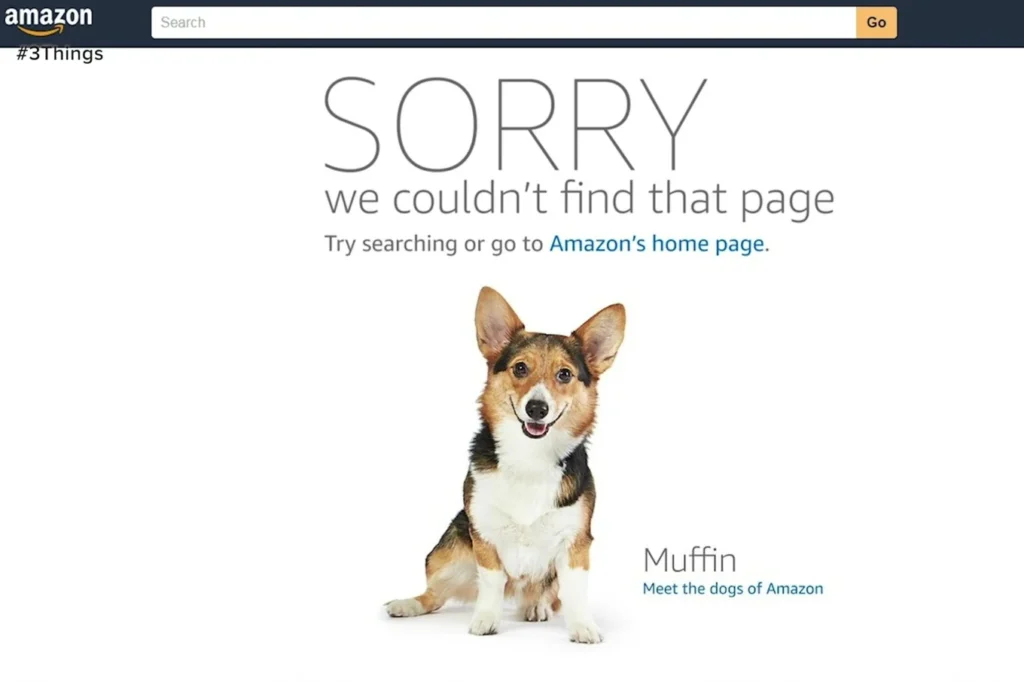
Amazon: a charming dog, a link to the homepage, and a search box. Fun, but the visitor still has to start over.
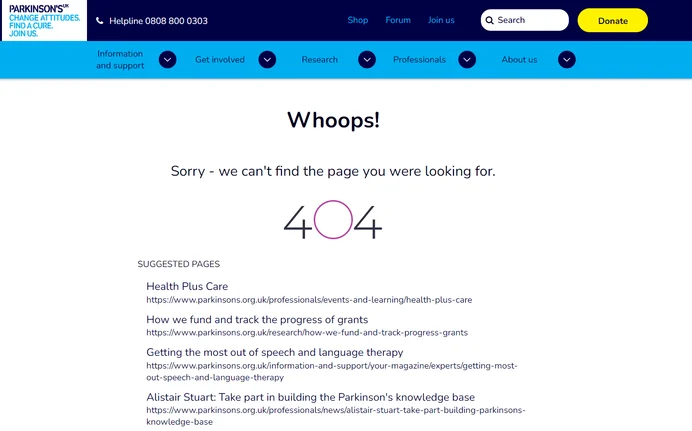
Parkinson’s UK: a short apology, then suggested pages based on what the visitor was likely looking for.
Creative 404 pages are fun. But on their own, they don’t take visitors anywhere.
How many visitors are you losing to dead ends?
Get an audit of how people search on your site, including where they’re giving up.
How to build a better 404 page
The key to moving visitors through your site smoothly is to stop thinking of your 404 page as a static page and start treating it as a dynamic landing page.
The problem with most 404 pages is that they focus on apologizing for the missing page instead of getting the visitor to the content they were looking for.
We now have the technology to give visitors a smooth, meaningful experience instead. A truly useful alternative to the classic 404 needs two things:
Predictive
It offers options that match the content the visitor was trying to reach.
Intuitive
It gives the visitor an easy, obvious path to that content.
From a usability perspective, that means you briefly acknowledge the broken link, and then make the suggested pages the main focus of the page.
The best way to do this is with the same kind of AI and machine learning that powers a modern site search engine. It uses a range of data points, including the words in the broken URL itself, to find the pages most relevant to what the visitor wanted. Because it learns from millions of search queries and visitor behavior, it keeps improving its suggestions automatically, so the most up-to-date results show up even on a page that doesn’t exist.
A dynamic page that puts relevant options front and center makes your website far stickier and improves conversion rates by keeping visitors engaged.
Use 404 data to improve engagement
Beyond creating a better visitor experience, intelligent 404 pages are also a source of very useful data. 404 analytics can show you:
How many
How many 404s your site generates, and which broken URLs visitors hit most.
Where to
Where visitors go next from your 404 pages.
How well
The success rate of those redirected visitors.
Digging into this data gives you a clearer picture of which content is working on your site, and where the gaps are that you need to fill to keep people engaged.
The best way to measure the accuracy of your intelligent 404 is Mean Reciprocal Rank (MRR). MRR is a statistical measure for evaluating any process that returns a ranked list of possible answers, ordered by how likely they are to be correct.
How MRR works: each time a visitor lands on a 404, look at where the right page appeared in your suggestions.
Average those scores across all your 404s, and you get your MRR. The closer to 1, the better your 404 page is at getting people where they meant to go.
A well-built intelligent 404 page delivers relevant results with a high MRR score, keeping people engaged on your site. In simple terms: it gets people to stick around, and helps you turn them into customers.
It’s also important to keep finding and fixing the 404s that come from your own site. Many organizations don’t even know how many 404s their websites generate, and every one of them is a missed opportunity to engage a visitor.
Implementing an out-of-the-box intelligent 404
Building and maintaining an AI-driven 404 system yourself, which matters most for larger websites, takes time, technical know-how, and ongoing resources. If your organization doesn’t have that capacity, an out-of-the-box solution can work wonders.
Cludo’s Intelligent 404 uses your Cludo search engine to create smart pathways to relevant content when the URL a visitor lands on doesn’t exist.
Beta test results
Broken links, rescued
In a beta test with large organizations including Vodafone Australia, Parkinson’s UK, and the Bank of England, Cludo’s Intelligent 404 pages moved visitors from broken links to relevant pages every month, for each customer.
Source: Cludo beta test data
Setting it up is quick. In Cludo’s Experience Builder:
- Choose your search engine and create a new experience.
- Select “404 Page” as the experience type.
- Pick what to show: related pages, trending content, popular pages, or hand-picked suggestions, plus your title, description, and layout.
- Match your brand with colors, alignment, and button styles, right in the builder.
- Add it to your 404 template with a CSS selector or a snippet of HTML, and start tracking where visitors go next.
You can read the full setup guide in the Cludo Help Center, or see it in action by booking a demo.
Frequently asked questions
What causes 404 errors?
404 errors happen when a visitor requests a page that doesn’t exist. Common causes include pages that were renamed, moved, or deleted without a 301 redirect, typos in URLs, outdated bookmarks, and old links from emails, social media, other websites, and AI assistants. Only about 17% of 404s come from broken links on your own site.
Do 404 errors hurt conversions?
Yes. Research has found that 73.72% of people who reach a 404 page leave the website and don’t return, so every 404 is a potential lost visitor, lead, or customer.
What should a good 404 page include?
A good 404 page briefly acknowledges that the page is missing, then focuses on getting the visitor to the right content. That means suggested pages based on what they were likely looking for, plus a search box. Humor is fine, but it shouldn’t replace a clear path forward.
What is an intelligent 404 page?
An intelligent 404 page uses search technology to suggest the pages a visitor most likely wanted when they land on a broken link. It turns a dead end into a dynamic landing page, and tracks where visitors go next so you can measure and improve it.
How do you measure how well a 404 page works?
Track how many visitors hit 404 pages, where they go next, and how often they reach a relevant page. Mean Reciprocal Rank (MRR) measures how high the right page appears in your suggestions: 1 if it’s first, 0.5 if it’s second, and so on, averaged across all visits.
Turn dead ends into next steps
See how Cludo’s Intelligent 404 and AI search keep visitors moving, even when a link breaks.
Related Posts
The benefits of adding search to your website | Cludo
When looking to optimize the user experience throughout your website, an intelligent search function…
Track zero search results in Google Analytics
If you are tracking what users are searching for, and which results perform the best, you can use them to improve your site…
Search vs. navigate: How people behave on websites?
Navigating and searching are both important ways of finding desirable content. How important is the search box…
